What to Do When a Fall-Risk Screening Finds a Concern
Category:
You completed a fall-risk screening and something showed up.
Maybe walking speed was slower than expected. Perhaps getting up from a chair was more difficult. Balance or mobility raised a concern. Or a strength measurement wasn’t where you hoped it would be.
So what happens now?
The most important thing to understand is that a screening is a starting point—not a diagnosis.
Finding a potential concern doesn’t tell you exactly why it exists, and it doesn’t automatically mean someone is going to fall.
What it does provide is information.
And information gives you an opportunity to ask better questions and take appropriate action before a fall or other event forces the issue.
Step 1: Don’t Ignore the Result
It can be tempting to dismiss a result:
“I was tired today.”
“I’ve always walked slowly.”
“That chair was harder to get out of than mine at home.”
Any individual measurement should be viewed in context. But if a screening identifies an area of concern—particularly when it matches changes you or your family have already noticed—it may be worth exploring further.
Has walking become more difficult?
Are stairs harder than they used to be?
Is getting out of a chair requiring more effort?
Have there been recent stumbles, near-falls or falls?
Has someone started avoiding activities they previously did comfortably?
The screening result may simply be another piece of a larger picture.
Step 2: Consider Talking With Your Healthcare Provider
A fall-risk screening does not diagnose the reason for a change in strength, balance or mobility.
There can be many factors involved, which is why concerns—particularly recent falls or significant changes—should be discussed with an appropriate healthcare provider.
Bring the screening information with you.
Objective results may help support a more informed conversation about what you’re experiencing and whether additional evaluation or intervention is appropriate.
Step 3: Look at the Home
The person is only one part of the equation.
If strength or mobility has changed, take another look at the environment in which everyday activities are happening.
Are pathways clear?
Is lighting adequate, particularly between the bedroom and bathroom at night?
Are stairs becoming difficult?
Is getting into or out of the shower challenging?
Is a favorite chair now too low to get out of comfortably?
Are frequently used items difficult to reach?
A home that worked perfectly five years ago may need to work differently today.
Sometimes relatively simple changes can make everyday activities easier and safer.
Step 4: Explore Ways to Address Strength and Mobility
If a screening identifies an area of concern, ask what can appropriately be done about it.
Depending on the situation and guidance from healthcare professionals, there may be opportunities to address strength, balance or mobility.
The right response will be different for every individual.
The important point is that identifying a concern doesn’t have to be the end of the conversation.
It can be the beginning of a plan.
Step 5: Consider Whether Everyday Support Is Needed
Sometimes the concern isn’t only a measurement.
Perhaps bathing has become difficult. Getting dressed takes much longer. Preparing meals requires more standing than someone can comfortably manage. A spouse is increasingly worried about leaving the other person alone.
That’s when it can be helpful to look beyond the screening result and ask a broader question:
How is this affecting everyday life?
For some families, additional support at home may be part of the answer.
For others, the right solution may involve healthcare professionals, home modifications, exercise or strength programs, assistive equipment, community resources—or a combination of approaches.
Home care is one option, not automatically the answer.
Step 6: Establish a Baseline and Watch for Change
One advantage of objective screening is the ability to establish a baseline.
Rather than relying only on “Mom seems slower than she was six months ago,” objective measurements can provide something to compare over time.
Has strength improved?
Has mobility remained stable?
Has something changed?
Tracking can help families recognize trends that might otherwise be difficult to see.
The Goal Is Prevention, Not Prediction
No screening can promise that someone will—or won’t—fall.
The value is in identifying potential concerns and creating an opportunity to act.
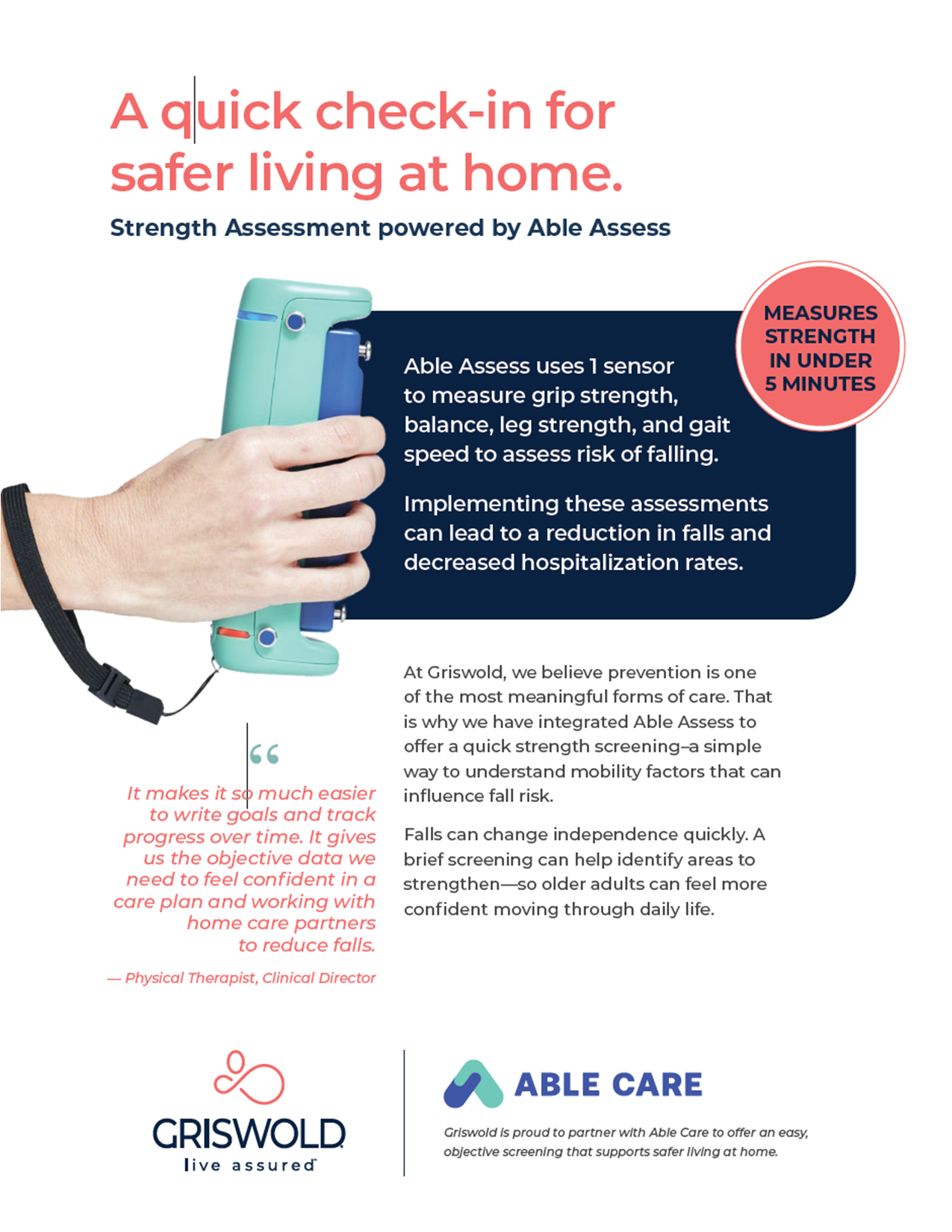
At Griswold Care Pairing, our Strength Assessment powered by Able Assess looks at grip strength, chair stand, Timed Up & Go, and gait speed to provide objective information related to strength and mobility.
The screening takes less than five minutes and can provide a baseline for future comparison.
But the assessment is only the beginning.
The real value comes from asking:
What did we learn, and what—if anything—should we do next?
Sometimes the answer is a conversation with a healthcare provider.
Sometimes it’s making the home easier to navigate.
Sometimes it’s addressing strength or mobility.
Sometimes it’s adding support with everyday activities.
And sometimes it’s simply continuing to pay attention.
The goal isn’t to create fear about falling.
It’s to provide better information that can help older adults remain as safe, active and independent as possible.
Contact Griswold Care Pairing to learn more about our Strength Assessment powered by Able Assess and how a quick check-in can provide objective information about strength and mobility.
The screening and GripAble hand-held device are for prevention-support purposes only. The screening is not a medical exam and does not diagnose medical conditions. If you have concerns or have experienced recent falls, talk with your healthcare provider.
Subscribe
Date: August 27, 2026
Category: