What Strength and Mobility Can Tell Us About Aging Safely at Home
Category:
Most of us don’t think very much about getting out of a chair, walking across a room or turning around.
We simply do it.
But as we age, changes in these everyday movements can provide useful information about strength, mobility and our ability to continue functioning independently.
The challenge is that these changes are often gradual. An older adult may compensate without realizing it—or family members may simply assume that moving more slowly is a normal part of getting older.
That’s why taking an objective look at strength and mobility can be helpful.
Four Simple Areas Can Tell Us a Lot
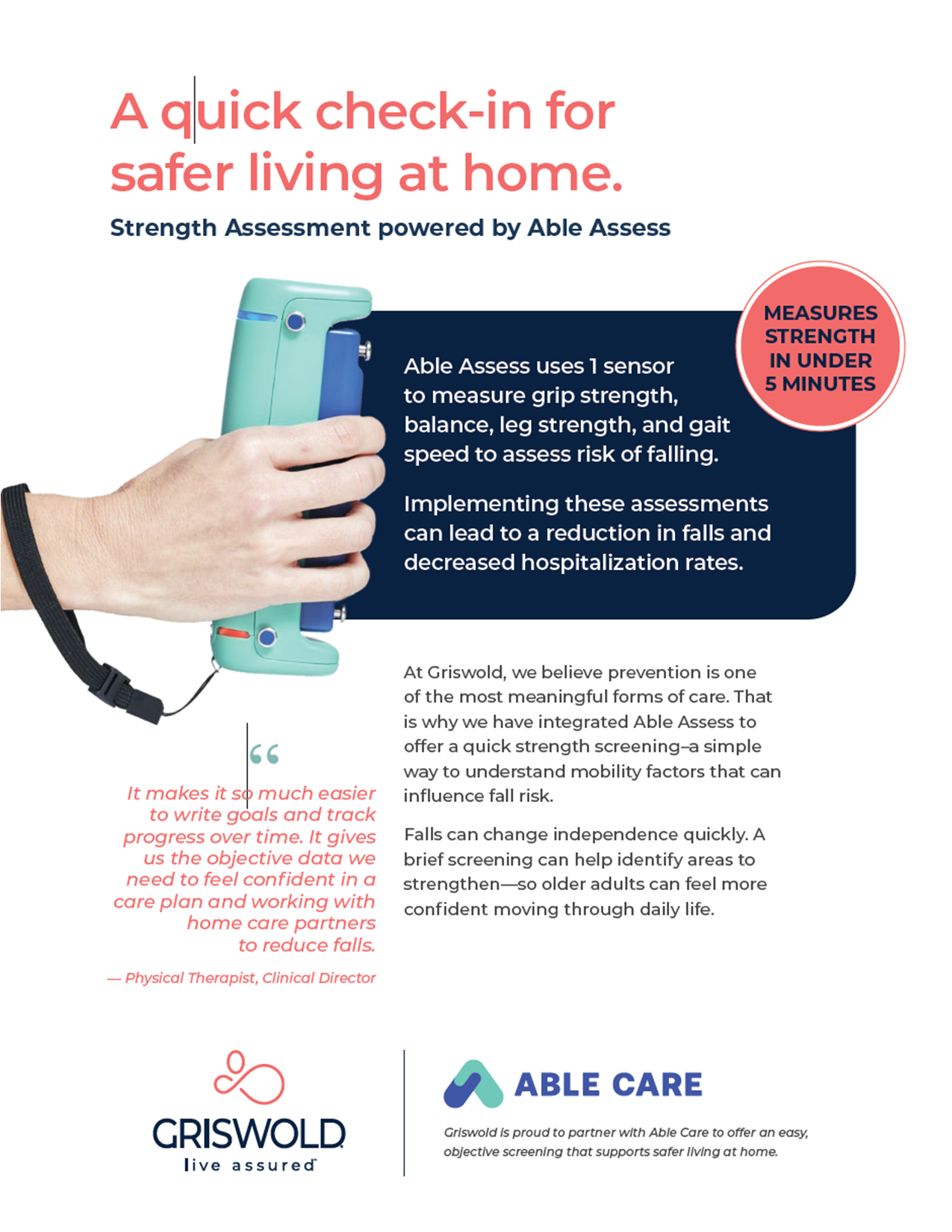
Griswold Care Pairing’s Strength Assessment powered by Able Assess looks at four areas: grip strength, chair stand, Timed Up & Go, and gait speed.
Together, they provide an objective snapshot of different aspects of strength and mobility.
Grip Strength
Why measure someone’s hand grip when we’re concerned about falls and independence?
Grip strength can serve as a simple indicator associated with overall strength and resilience.
Rather than relying only on whether someone feels weaker than they used to, measuring grip strength provides objective information that can become part of a broader picture of how that person is functioning.
Chair Stand
Think about how many times each day we get up from a chair, sofa, bed or toilet.
The chair stand looks at lower-body strength, which is important for getting up safely and maintaining stability.
Families sometimes notice this change before they recognize it as a strength issue. An older adult may begin pushing heavily with both arms to get out of a chair, rocking forward several times before standing, or avoiding lower chairs altogether.
Those small changes can be worth paying attention to.
Timed Up & Go
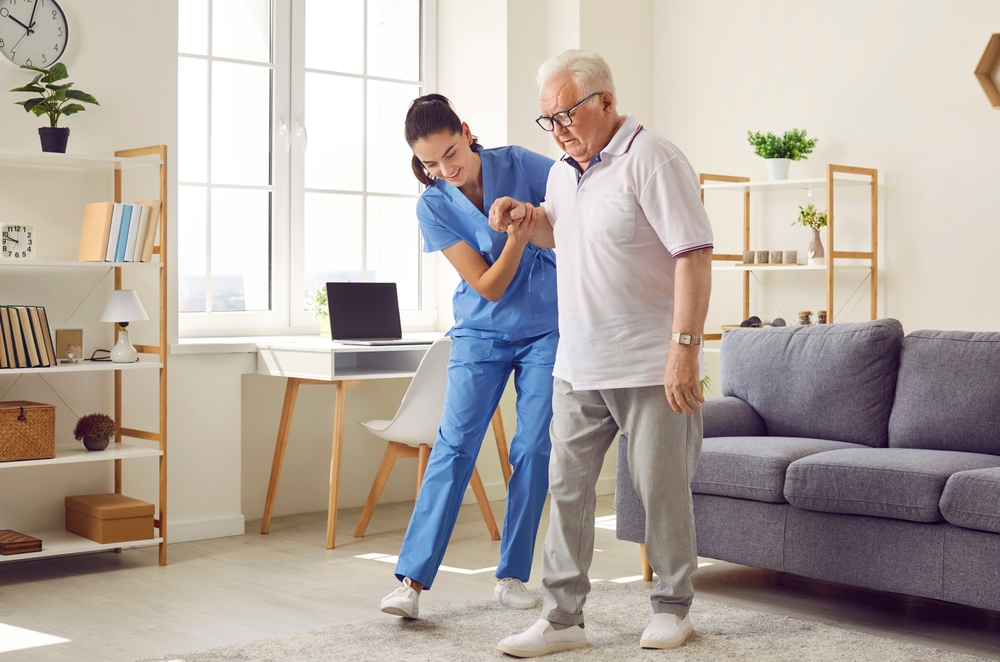
The Timed Up & Go test looks at an everyday sequence of movements:
Stand. Walk. Turn. Walk back. Sit.
That simple sequence provides information about balance and functional mobility.
It resembles the kinds of movements we make throughout the day—getting up to answer the door, walking to the kitchen or moving from one room to another.
Gait Speed
Gait speed measures walking pace and is often linked with functional independence.
Again, the value isn’t simply deciding whether someone walks “fast” or “slow.” It provides another objective measurement that can be considered alongside the other areas.
Together, these measures can provide a more complete picture than any one observation alone.
Why Objective Information Can Help
Families usually make observations informally:
“Dad seems slower.”
“Mom doesn’t get around as easily anymore.”
“She seems less steady than she used to.”
Those observations matter. But it can be difficult to know whether something has actually changed—or how much.
The Strength Assessment powered by Able Assess provides objective results that can establish a baseline.
That can be valuable because a baseline gives us something to compare against later. Instead of relying entirely on memory or impressions, changes in strength and mobility can be tracked over time.
The assessment itself takes less than five minutes.
Screening Is a Starting Point, Not a Diagnosis
It is important to understand what this information does—and does not—tell us.
A strength and mobility screening is not a medical examination and does not diagnose a medical condition.
Instead, it provides information that can support prevention conversations and help identify areas that may deserve additional attention.
If a screening raises a concern, the appropriate next step depends on the individual. That might mean discussing the results with a healthcare provider, looking more closely at the home environment, exploring ways to improve strength or mobility with an appropriate professional, or considering whether additional support with everyday activities would be helpful.
The objective isn’t to turn every result into a service.
It’s to have better information from which to make good decisions.
Staying Independent Starts With Knowing Where You Are Today
Most older adults want to remain active and independent for as long as possible.
One way to support that goal is to pay attention to changes before they become a crisis.
How easily can you get out of a chair?
How comfortably do you walk and turn?
Has your walking pace changed?
How does your strength today compare with where it may be in the future?
We routinely measure other things because knowing where we stand helps us make informed decisions. Strength and mobility can be worth checking too.
Want to know where you stand?
Contact Griswold Care Pairing to learn more about our Strength Assessment powered by Able Assess—a quick, objective check-in designed to support safer living at home.
The screening and GripAble hand-held device are for prevention-support purposes only. The screening is not a medical exam and does not diagnose medical conditions. If you have concerns or have experienced recent falls, talk with your healthcare provider.
Subscribe
Date: August 19, 2026
Category: