Strength, Mobility and Home Safety: What Pasco County Families Should Watch For
Category:
For many families, concern about an older parent’s safety begins with something obvious—a fall, a hospitalization or a sudden change in health.
But sometimes the signs appear much earlier.
Mom needs both hands to push herself out of a chair. Dad walks more slowly than he used to. Someone begins avoiding the stairs or holding onto furniture while moving through the house.
These changes don’t necessarily mean an older adult can no longer live independently.
But they can be reasons to take a closer look at strength, mobility and how safely someone is functioning at home.
Why Strength Matters More Than We Sometimes Realize
Strength affects many ordinary activities we rarely think about until they become difficult.
Consider how much strength is involved in:
- Standing up from a chair
- Getting out of bed
- Stepping into a shower
- Getting on and off the toilet
- Climbing stairs
- Carrying groceries
- Getting into and out of a car
A person doesn’t need to be an athlete to perform these activities. But maintaining enough strength to perform them comfortably can be important to remaining independent.
Families may notice changes gradually.
Someone who once stood easily may begin pushing off with both hands. A person may choose a higher chair because it’s easier to get out of. Another may stop doing something altogether rather than admit that it has become difficult.
Those small adaptations are worth noticing.
Mobility Is About More Than Walking
When we talk about mobility, it’s easy to think only about whether someone can walk.
But everyday mobility involves much more.
Can the person stand up, begin walking and change direction comfortably? Can they navigate around furniture? Can they get to the bathroom when they need to? Can they move safely from the bedroom to the kitchen at night?
Also watch for changes in how someone walks.
Have they become noticeably slower? Are their steps shorter? Are they reaching for walls or furniture? Do they seem hesitant on uneven surfaces?
Again, none of these observations provides a diagnosis.
They are simply information that can help a family recognize that something may have changed.
Look at the Person and the Home Together
Home safety isn’t just about the house.
And it isn’t just about the person.
It’s about how the person functions within that particular environment.
A staircase may have been perfectly manageable for 20 years. If someone’s strength or mobility changes, the same staircase may present a new challenge.
A low sofa may suddenly become difficult to get out of. A bathroom may need additional support. Poor lighting may matter more to someone whose vision or balance has changed.
Walk through the home and look at it from the older adult’s perspective.
Ask:
- Are walking paths clear?
- Is lighting adequate, especially at night?
- Are frequently used items easy to reach?
- Are there loose rugs or other tripping hazards?
- Is getting into and out of the shower difficult?
- Are stairs becoming challenging?
- Are chairs and beds easy to get into and out of?
- Has the person stopped using certain areas of the home?
Sometimes the best clues come from noticing what someone no longer does.
Pay Attention to Near-Falls, Too
Families understandably pay attention when someone falls.
Near-falls can be important as well.
Maybe Dad caught himself on the kitchen counter. Mom stumbled getting out of the shower but grabbed the towel bar. Someone lost their balance stepping off a curb but didn’t actually hit the ground.
Because no injury occurred, these incidents are easy to dismiss.
Instead, they can be an opportunity to ask whether something has changed before a more serious event occurs.
Objective Information Can Help Family Conversations
Safety conversations between parents and adult children aren’t always easy.
An adult child may say:
“Dad, I’m worried about you living here.”
Dad may hear:
“You want to take away my independence.”
That’s why objective information can be useful.
Instead of beginning with the conclusion that someone needs home care or needs to move, families can begin by looking at how the person is actually functioning.
How easily can they stand from a chair?
How is their mobility?
Has their walking changed?
How well does the home environment match their current abilities?
The goal isn’t to prove that someone can’t remain at home.
It’s to identify areas that may deserve attention so the family can make better-informed decisions.
What Should You Do if Something Concerns You?
A concern doesn’t automatically mean someone needs home care.
Depending upon what you observe, it may be appropriate to talk with the person’s physician or another healthcare professional. Physical or occupational therapy may be appropriate in some situations. Changes to the home, community resources, technology or additional family assistance may help.
And sometimes additional help with everyday activities can make remaining at home easier.
The right response depends on what the concern actually is.
A New Way to Look at Staying Independent
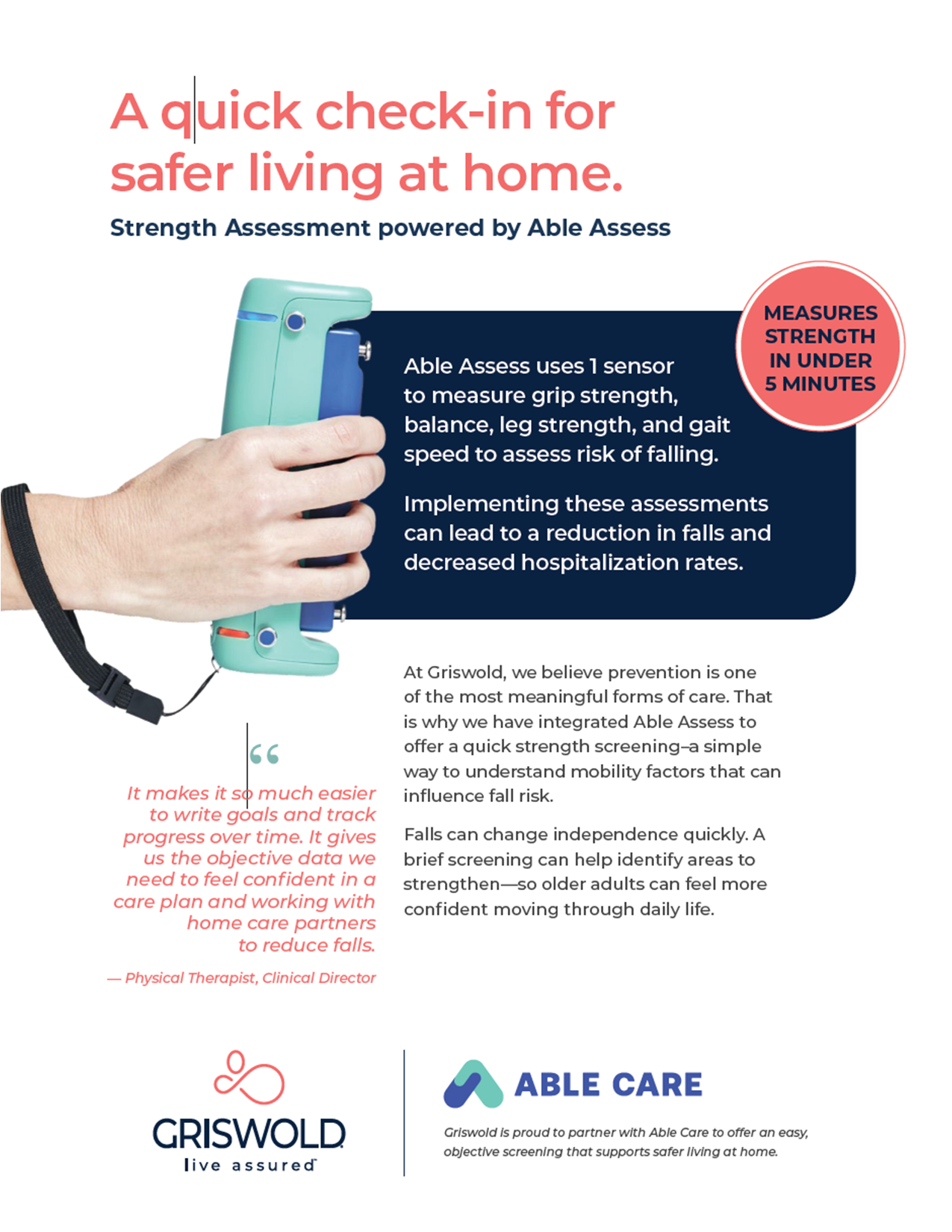
Griswold Care Pairing Tampa/Pasco is adding a new resource designed to help families look more objectively at factors associated with strength, mobility and fall risk.
Our Able Care/Able Assess approach uses brief functional measurements to provide additional information about how an older adult is doing.
This is not a medical diagnosis, and it does not replace evaluation or treatment by a physician, physical therapist or other healthcare professional.
Instead, the goal is to help families identify potential concerns earlier and determine whether additional evaluation, changes around the home or other support may be appropriate.
For a family wondering whether Mom or Dad is beginning to have difficulty at home, having something objective to discuss can be a useful place to start.
Staying Independent Starts With Knowing Where You Are
Most families would rather address a small concern today than respond to a crisis tomorrow.
If you’ve noticed changes in the strength, mobility or everyday functioning of an older adult in Wesley Chapel, Land O’ Lakes, Trinity, New Port Richey or elsewhere in Pasco County, don’t ignore them simply because a fall hasn’t happened.
Take a closer look.
Ask questions.
And when appropriate, involve the person’s healthcare professionals.
The purpose isn’t to limit someone’s independence.
It’s to identify what may help them preserve it.
Want a clearer picture of how a loved one is functioning at home?
Contact Griswold Care Pairing Tampa/Pasco to learn more about our strength, mobility and fall-risk resources and how we help Pasco County families explore options for remaining safely and independently at home.
Subscribe
Date: October 22, 2026
Category: