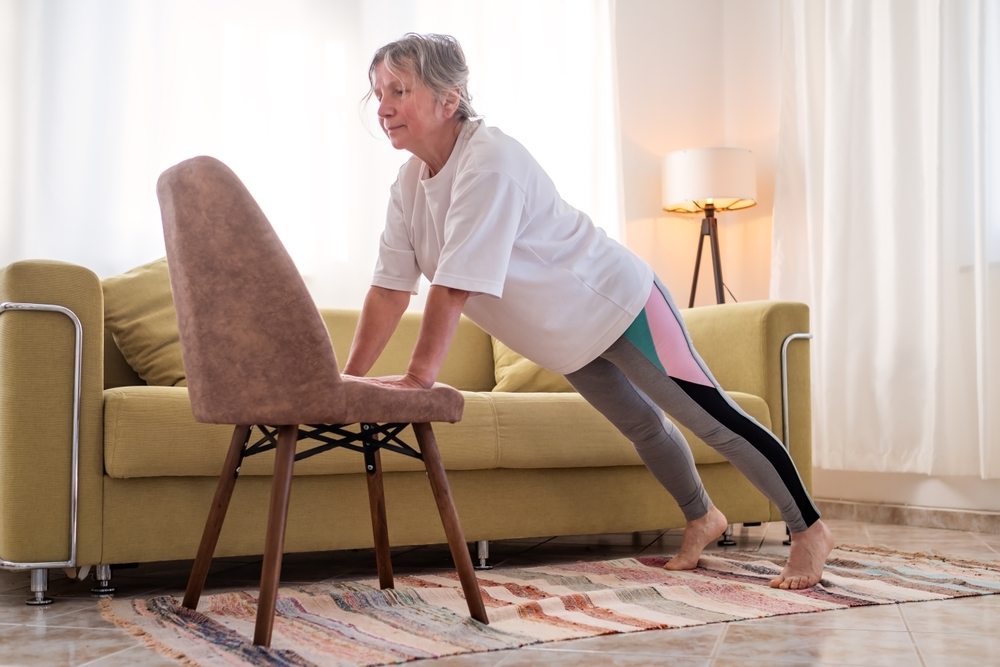
Resistance Training for Elderly Adults
Category:

Research has long since confirmed that resistance training (also known as strength or weight training) has health benefits for people of all ages and levels of fitness. However, regular resistance training for seniors offers the incredible benefits of maintaining your strength, mobility, and overall independence as they age.
In this post, we’ll explore the benefits of resistance training for older adults and help you start building a workout of senior-safe, beginner-friendly resistance exercises for the elderly.
Download Our FREE Guide to Heart Health
Senior Resistance Training
Resistance training is a great way for seniors to stay active because it requires a small investment of time and minimal equipment for you to get started. Some seniors may be intimated by the idea of “strength training” and have concerns about injuring themselves. However, if done properly, resistance training is safe, even for people with health problems.
By choosing the right exercises and following proper safety guidelines, people of any age or fitness level can safely benefit from resistance training. If you’re still unsure if these exercises are safe for you, consult your doctor.
Benefits of Resistance Training for Older Adults
Benefits of resistance training for older adults include:
- Boosting energy
- Building strength
- Maintaining bone density
- Improving balance, coordination, and mobility
- Reduce your risk of falling
- Maintain independence
Resistance training for older adults is also associated with the treatment or prevention of common chronic issues:
- Arthritis: Resistance training can help treat symptoms of arthritis by reducing pain and stiffness while also increasing strength and flexibility.
- Back pain: Resistance training eases back pain by strengthening the back and abdominal muscles to reduce stress on the spine.
- Diabetes: Resistance training has been shown to improve glycemic control in those with diabetes.
- Heart disease: Overall fitness is linked to a reduced risk of heart disease.
- Obesity: Resistance training increases the body’s metabolism.
- Osteoporosis: Resistance training helps build bone density, which reduces risk for falls.
Simple Resistance Training Exercises for the Elderly
Squats
- Stand with your feet shoulder-length apart in front of a sturdy chair that you can easily stand up from and extend your arms in front of you so they are parallel to the floor.
- Bend your knees as you slowly lower your butt towards the chair while counting to four.
- Pause before slowly rising up to a stand position while counting to two.
- Repeat 10 times to complete one set.
- Rest for one minute before completing a second set of 10 squats.
Pro Tips:
- Your weight should be placed on your heels rather than the balls of your feet.
- Keep your knees in line over your ankles.
- Keep your back straight.
Wall Push-Ups
- Stand an arm’s length away from an empty wall. Lean forward and place your hands flat against the wall shoulder-length apart and at shoulder-height.
- Slowly bend your elbows as you lower your upper body toward the wall while counting to four.
- Pause before slowly pushing yourself back up until your arms are straight while counting to four.
- Repeat 10 times to complete one set.
- Rest for one minute before completing a second set of 10 squats.
Pro Tips:
- Keep your feet planted on the floor and your hands planted on the wall.
- Don’t lock your elbows.
- Don’t arch your back.
Toe Stands
- Stand with your feet shoulder-length apart near a counter, table, or sturdy chair for balance.
- Slowly push up as far as you can on the balls of your feet while counting to four.
- Hold this position for two to four seconds before slowly lowering your heels back to the floor while counting to four.
- Repeat 10 times to complete one set.
- Rest for one minute before completing a second set of 10 squats.
Pro Tips:
- Don’t lean on the counter, table, or chair. It should only be used for balance.
Finger Marching
- Stand or sit in a chair with your feet flat on the floor and shoulder-width apart.
- Imagine there is a wall in front of you and slowly walk your fingers up the wall until your arms are above your head.
- Hold your hands above your head and wiggle your fingers for 10 seconds before slowly walking them back down.
- Rest for one minute.
- Move your arms behind your back and grab your opposite wrist with one hand. If you can, reach for your elbow (or get as close as you can). Hold this position for 10 seconds.
- Release your arms and rest for one minute.
- Interlace your fingers in front of your body and raise your arms so they’re parallel to the floor.
- Rotate your hands so your palms are facing the imaginary wall.
- While standing straight, curl your shoulders forward. Hold this position for 10 seconds.
- Rest for one minute before completing a second set of each step.
To learn more about our home care services, contact our caregiving team today at 1-800-GRISWOLD or find a Caregiver near you.
Subscribe
Date: 2026-01-28
Category: